
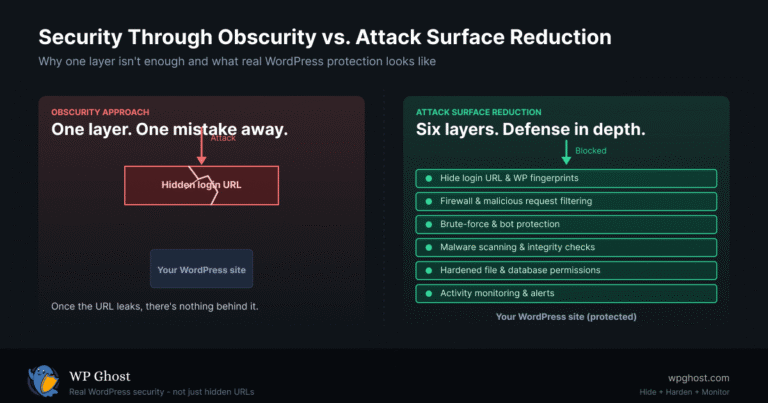
The honest technical answer, with the principles, the framework references, and the data.
If you’ve read about WordPress security on developer forums, security blogs, or Reddit, you’ve probably seen the argument that hiding the WordPress login URL is “security through obscurity” – and therefore not real security.
It’s a fair concern. “Security through obscurity” is a real anti-pattern in cybersecurity, well-documented and rightly criticized. So the question deserves a serious answer, not a marketing one.
Short answer: No, WP Ghost is not security through obscurity. It implements Attack Surface Reduction, a recognized cybersecurity principle defined in NIST SP 800-160 and used across enterprise security frameworks including ISO 27001 and OWASP. Path security is one independent layer in a defense-in-depth strategy, not a substitute for the other layers.
This article explains the precise technical difference, addresses the common counter-arguments fairly, and shows the empirical data that backs the approach.
What “Security Through Obscurity” Actually Means
The term comes from a foundational principle in cryptography and systems security, traceable to Kerckhoffs’s Principle (1883), formalized later by Claude Shannon as: “the enemy knows the system.” The idea is that a security system should remain secure even if everything about its design is public – only the keys should be secret.
Security through obscurity violates this principle. It means relying on hiding the design of a security mechanism, rather than the design being strong on its own, as the primary line of defense. The classic failure mode: a system that’s secure only because attackers haven’t yet figured out how it works. The moment they do, the entire defense collapses, because there’s nothing else holding it up.
Concrete examples of true security through obscurity:
- A login form with no rate limiting, no CAPTCHA, and no 2FA, but at a “secret” URL
- A database with no encryption, accessible because nobody knows the right port number
- An admin panel protected only by a non-default URL, with default credentials
- Encryption that works only because nobody knows the algorithm being used
In every case, the security collapses the moment the secret is revealed. There is no second layer. That’s why the security community treats obscurity-as-only-defense as a failure pattern.
The community is right to flag this pattern. WP Ghost agrees with the principle. We just don’t do that.
What Attack Surface Reduction Actually Means
Attack Surface Reduction (ASR) is a different concept entirely. It’s defined in NIST Special Publication 800-160 Volume 1 as the systematic minimization of the points where an unauthorized user can attempt to enter or extract data from a system. ASR is part of the Defense in Depth model, which assumes every layer can fail and designs multiple independent layers so a single failure does not compromise the system.
ASR doesn’t replace strong authentication, firewall filtering, or monitoring. It supplements them by reducing the number of opportunities an attacker has to interact with the system in the first place. Fewer exposed endpoints means fewer attack vectors means fewer chances for any single weakness to be exploited.
Examples of attack surface reduction in widely-respected security practice:
- Disabling unused services on a server. An SSH daemon listening on port 22 is an attack surface even if it has strong authentication. Disabling SSH entirely on web servers that don’t need it is ASR.
- Moving SSH to a non-standard port. Recommended in widely-used Linux hardening guides, not because port 22 is insecure, but because the volume of automated SSH brute force traffic is dramatically reduced when the service isn’t where bots expect it.
- Removing unnecessary HTTP headers that reveal server software and version. The Apache or Nginx version number isn’t a vulnerability by itself, but exposing it lets attackers narrow their exploit selection.
- Disabling directory listing on web servers. The files exist either way; preventing the directory enumeration removes a reconnaissance step.
- Network segmentation. Putting a database server behind a firewall on an internal network, even if the database has strong authentication, reduces its attack surface.
None of these are considered “security through obscurity” by serious security practitioners. They’re standard hardening practice. They work because they reduce the number of automated attacks the system has to defend against, freeing the strong defenses (authentication, encryption, monitoring) to focus on the small fraction of attacks that survive the first layer.
This is exactly what WP Ghost does for WordPress.
The Difference, Side by Side
| Security Through Obscurity | Attack Surface Reduction (WP Ghost) |
|---|---|
| Hide one detail and hope nobody finds it | Reduce reconnaissance opportunities AND filter requests AND harden authentication AND monitor threats |
| Single point of failure | Multiple independent security layers |
| If the secret is leaked, security is gone | If a path is discovered, the firewall, brute force protection, 2FA, and IP blocking still apply |
| No measurable protection | Verifiable: 100M+ blocked attacks per month, logged and auditable |
| Not part of any recognized security framework | Aligned with NIST SP 800-160, OWASP, and ISO 27001 principles |
| Replaces other defenses | Supplements other defenses; explicitly designed to coexist with malware scanners and hosting firewalls |
The Defense Layers WP Ghost Adds Independently of Path Security
The clearest way to prove WP Ghost is not security through obscurity is to show what happens if you assume the path secret is broken. If WP Ghost relied on path obscurity alone, an attacker who discovered your custom login URL would have full access. They don’t. Here’s why.
Even with the secret path exposed, the following layers remain in effect, each one operating independently of path security:
Layer 1: Server-Level Firewall (7G/8G)
The 7G and 8G Firewall rulesets inspect every incoming request at the web server level (Apache or Nginx), before WordPress loads. They block SQL injection patterns, cross-site scripting payloads, file inclusion attempts, malicious user agents, and known exploit signatures. This works on any URL, including the custom login path. Discovering the path doesn’t bypass the firewall.
Layer 2: Brute Force Protection
Login attempt limits and CAPTCHA challenges apply to the login form regardless of which URL serves it. An attacker who finds the custom path still has to defeat reCAPTCHA (Math, Google V2, V3, or Enterprise) and survive the configurable attempt limit before the IP is locked out.
Layer 3: Two-Factor Authentication
WP Ghost includes free 2FA via authenticator code, email, or passkey. Passkeys (Face ID, Touch ID, Windows Hello, hardware keys) eliminate phishing risk entirely because there is no password to steal and no code to intercept. Even with a known login URL and a valid password, an attacker without the second factor cannot get in.
Layer 4: Automated IP Blocking
WP Ghost Premium tracks repeat offenders. An IP address that triggers security rules failed logins, firewall blocks, suspicious request patterns, is permanently banned at the server level after a configurable threshold. The next request from that IP is rejected before WordPress loads, regardless of which URL it targets.
Layer 5: Geo Blocking (Premium)
Country-level access restrictions reject traffic from regions you’ve blocked, before any URL-level checks happen. If your site has no legitimate visitors from a country that produces 80% of your attack traffic, the geo block stops those attempts entirely.
Layer 6: Threat Logging & Monitoring
The Security Threats Log records every blocked attack, with origin IP, target path, and rule triggered. The Interactive GEO Threat Map visualizes attack origins. If an attacker did discover the custom URL and started attempting access, the logging layer would show it, making detection and response possible in a way that obscurity-only “security” cannot.
Path security is the first layer. It is not the only layer. Each layer above operates regardless of what attackers know about the URL structure. Together they form what NIST and OWASP call defense in depth, the principle that security is the product of overlapping independent defenses, not any single mechanism.
The Empirical Argument: Why Path Security Works
The principles above explain why WP Ghost is not security through obscurity. The empirical data explains why path security also independently works.
Patchstack’s 2026 State of WordPress Security report confirms what every WordPress security operator already knows: the overwhelming majority of attacks against WordPress sites are automated. Bots running from compromised servers, residential proxies, and botnets perform the reconnaissance and exploitation phases on millions of sites simultaneously.
These bots do not guess. They use hardcoded target lists. The reconnaissance phase looks like this:
- Request
/wp-login.php. If 200 OK, target confirmed as WordPress. - Request
/wp-content/plugins/with directory listing probes. - Request
/?author=1to enumerate usernames. - Request
/wp-json/wp/v2/usersas a backup enumeration method. - Begin attack queue: brute force the login, probe known plugin vulnerabilities, attempt SQL injection on common endpoints.
The moment /wp-login.php returns 404 at the web server level, the script’s confirmation step fails. The bot does not pivot to alternative paths. It does not perform reconnaissance to find the new URL. The bot moves on to the next site, because attacking at scale is an economic activity, wasting compute on individual reconnaissance is unprofitable when there are millions of unprotected targets available.
This is not a theoretical claim. Across 10 years of operational observation on the WordPress sites our company manages, we’ve consistently measured up to 90% reduction in bot attack volume after activating path security alone, and up to 99% reduction with the full configuration (Ghost Mode + 8G Firewall + Brute Force Protection). Some managed sites went from hundreds of daily attack attempts to 1–3.
The reason: attackers are not the genius outsiders the term “security through obscurity” assumes. The vast majority are bots running scripts. Path security defeats those bots completely. The remaining attack volume, the small fraction of sophisticated, targeted attempts, is what the firewall, brute force protection, 2FA, and IP blocking layers are designed for.
The Steel-Manned Counter-Argument
The strongest version of the criticism goes like this: “A determined attacker can find your custom login URL. Tools like dirb, gobuster, and ffuf brute-force directory paths in seconds. Hiding the URL only stops lazy attackers. Therefore path security is theater.”
This argument is partially correct, and we want to address it directly rather than dismiss it.
What’s correct about it: A targeted attacker who has decided your specific site is worth their time can attempt directory enumeration, examine HTTP responses for fingerprints, and eventually identify the login URL. Path security alone does not stop a sophisticated targeted attack against a specific high-value target.
What’s incomplete about it:
- Targeted attacks are a small minority. Most WordPress sites are not specifically targeted. They’re caught in mass scans. Path security defeats mass scans completely. Reducing the attack surface for the 99% of attacks that are automated is a significant security gain even if it does not stop the 1% that are targeted.
- Directory enumeration triggers other defenses. An attacker running gobuster against a WP Ghost-protected site is generating a high volume of 404 responses and unusual request patterns. The 8G Firewall flags suspicious user agents. Automated IP Blocking bans the source IP after a threshold. The directory brute-force itself becomes the attack the system detects and stops.
- Even if the URL is found, the other layers remain. A targeted attacker who eventually identifies the login URL still faces reCAPTCHA, brute force limits, 2FA with passkeys, and the firewall. Path security buys time and forces the attacker to expend resources before reaching the actual authentication challenge, which is exactly what defense in depth is for.
- Time and noise matter in security. Slowing an attacker down and forcing them to make detectable noise is not “theater”, it’s the entire principle behind intrusion detection systems, honeypots, and rate limiting. A defense that turns a 30-second attack into a 30-minute attack with detection events is a meaningful defense.
The honest position is this: path security is not a complete defense against a determined targeted attacker, and we do not claim it is. It is a layer that eliminates the reconnaissance phase for automated bots, which is the threat model that produces the overwhelming majority of WordPress compromises, and it makes targeted attacks slower, noisier, and easier to detect.
Combined with the other independent layers WP Ghost provides, this is what defense in depth looks like in practice.
Why the SSH Analogy Settles This
One of the cleanest ways to settle the “is moving the URL security through obscurity?” question is to look at how the security community treats the same practice in a different context.
Moving SSH from port 22 to a non-standard port is recommended in nearly every Linux server hardening guide, including those published by major hosting providers, the SANS Institute, and CIS Benchmarks. Nobody calls this “security through obscurity”, even though the mechanism is conceptually identical to moving a WordPress login URL.
Why is moving SSH considered legitimate hardening, while moving wp-login is sometimes called obscurity?
The answer is: it isn’t. The criticism is inconsistent. The same practice is considered standard security hardening when applied to SSH, and is considered controversial only when applied to WordPress, despite the underlying logic being identical:
- SSH on port 22 faces millions of automated brute force attempts per day from botnets. Moving to a non-standard port reduces that traffic by orders of magnitude. The actual SSH security (key authentication, fail2ban, rate limiting) remains in place. Nobody has called this obscurity in 20 years.
- WordPress at /wp-login.php faces millions of automated brute force attempts per day from botnets. Moving to a custom path reduces that traffic by orders of magnitude. The actual WordPress security (strong passwords, 2FA, brute force protection, firewall) remains in place. Some critics call this obscurity.
If moving SSH is hardening, moving wp-login is hardening. If you accept one, you accept the other. The principle is the same: reduce automated attack volume by removing the predictable target, while maintaining the strong authentication mechanisms that protect against the attacks that do find the new endpoint.
What WordPress Itself Says
The WordPress core security team’s public guidance on hardening explicitly recommends limiting login access, restricting wp-admin to specific IP ranges, and disabling file editing, all of which are forms of attack surface reduction. WordPress.org’s official Hardening WordPress documentation describes these as standard security practice, not obscurity.
WP Ghost extends these principles by removing the predictable URL structure that enables mass automated attacks in the first place. The plugin doesn’t modify WordPress core files. It uses standard WordPress hooks and server rewrite rules, the same techniques the WordPress core team uses for permalink rewriting and feed URL handling. Deactivating WP Ghost instantly restores all defaults.
Frequently Asked Questions
Is hiding the WordPress login URL considered security through obscurity?
No, when it’s combined with other security layers. Hiding the login URL alone, without rate limiting, CAPTCHA, 2FA, or firewall protection, would be obscurity-as-only-defense and would be a weak strategy. Hiding the login URL as part of a layered defense that also includes brute force protection, 2FA, and firewall filtering is attack surface reduction, which is recognized as standard security practice in NIST SP 800-160 and OWASP guidance.
What’s the difference between obscurity and attack surface reduction?
Security through obscurity uses hiding as the only defense, if the secret is revealed, security collapses entirely. Attack surface reduction uses hiding as one independent layer in a defense-in-depth strategy, if one layer fails, the other layers continue to operate. The structural difference is whether other defenses exist that work without the hidden detail.
Can attackers still find wp-admin if it’s renamed?
A determined human attacker using directory enumeration tools can eventually identify a custom login URL on a specific targeted site. Automated bots running mass scans cannot, they don’t perform per-site reconnaissance because attacking at scale is unprofitable when easier targets exist. WP Ghost defeats the automated 99% completely, and slows down the targeted 1% while the other defense layers (firewall, 2FA, IP blocking) handle the actual authentication challenge.
Does WP Ghost rely only on hiding paths?
No. Path security is one of multiple independent layers WP Ghost provides. The others include the 7G/8G application firewall, brute force protection with reCAPTCHA, two-factor authentication including passkeys, automated IP blocking, country-level geo restrictions, and full security threat logging. Each layer operates independently, so the discovery of a hidden path doesn’t compromise the other defenses.
Why is moving SSH ports considered hardening, but moving WordPress login URLs is sometimes called obscurity?
The criticism is inconsistent. The two practices are conceptually identical, both reduce automated attack traffic by removing the predictable target while keeping strong authentication mechanisms in place. Moving SSH ports has been considered standard hardening for decades. Moving WordPress login URLs is the same principle applied to a different application. Either both are hardening or both are obscurity; they cannot be different categories.
Does WordPress.org recommend hiding wp-login.php?
WordPress.org’s Hardening WordPress documentation recommends limiting access to wp-login.php, restricting wp-admin by IP, and disabling file editing, all forms of attack surface reduction. These are the same principles WP Ghost extends with path-level URL changes that work without server configuration access (which most WordPress users don’t have).
Does path security violate Kerckhoffs’s Principle?
No. Kerckhoffs’s Principle applies to the design of cryptographic systems, the algorithm should remain secure even if its design is public. WP Ghost’s design is public: the source code is available, the methodology is documented, and how it works is openly explained. The custom path is analogous to a key, not the algorithm. Kerckhoffs’s Principle states that the keys must be secret; it does not state that no secrets can exist anywhere.
If path security is so effective, why don’t all security plugins do it?
Most WordPress security plugins focus on detection and cleanup (malware scanning, integrity monitoring, threat intelligence) rather than prevention through architectural changes. Path rewriting is technically harder to implement compatibly across the WordPress plugin ecosystem, it requires careful handling of plugin AJAX calls, REST API endpoints, and theme dependencies. WP Ghost focuses on this specific layer and is officially compatible with the major scanning-focused plugins. Most users get the best protection by running both: a scanner for detection and WP Ghost for prevention.
Where can I see the actual data behind these claims?
The WP Ghost Impact Report publishes the network telemetry data (100M+ threats blocked monthly across 250,000+ protected sites), the methodology used to measure it, and the operational observations from 10 years of managing WordPress sites at MINBO QRE SRL. The report explicitly documents what we can measure, what we can’t measure, and why the published numbers are conservative.
In Summary
Security through obscurity is a real anti-pattern, and the WordPress security community is right to flag it. WP Ghost is not security through obscurity. It implements attack surface reduction, a recognized principle in NIST SP 800-160, ISO 27001, and OWASP frameworks, as one independent layer in a defense-in-depth strategy that also includes server-level firewall, brute force protection, two-factor authentication with passkeys, automated IP blocking, geo restrictions, and threat logging.
If WP Ghost relied on path obscurity alone, the criticism would be valid. It doesn’t. Each of the layers above operates independently of what an attacker knows about your URL structure. Path security simply removes your site from the target list of the automated bots that perform the overwhelming majority of WordPress attacks, freeing the strong defenses to focus on the small fraction of attempts that survive the first layer.
This is not theater. It is how attack surface reduction is supposed to work, and it is consistent with the practices that hardened systems, Linux servers, network appliances, enterprise applications, have used for decades.
Further Reading
- WP Ghost Impact Report – the empirical data behind the prevention claims
- What is WP Ghost? – the proactive prevention methodology in detail
- How to Prevent Hack Attacks on WordPress – practical configuration guide
- 7G & 8G Firewall – the application-layer filtering layer
- Two-Factor Authentication – passkeys, codes, and email verification
- Hacker Bot Attack Types – what the automated threats actually look like