
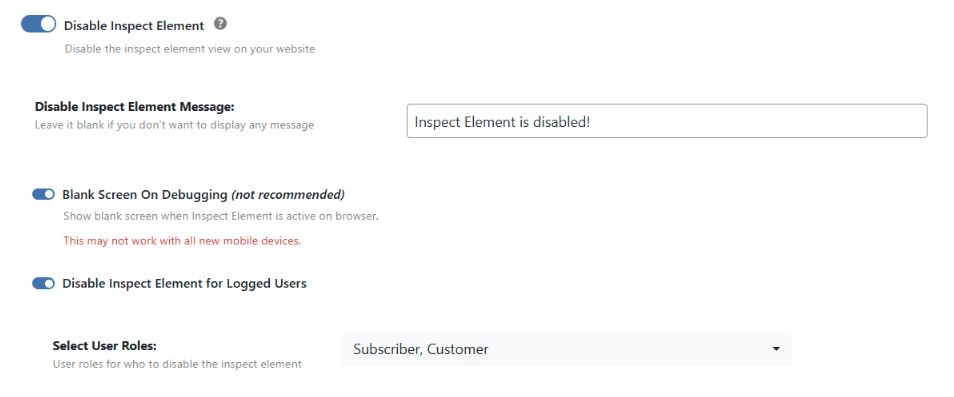
Yes. WP Ghost can disable Inspect Element with one toggle. Go to WP Ghost > Tweaks > Disable Options, switch on Disable Inspect Element, and save. That blocks the keyboard shortcuts (F12, Ctrl+Shift+I, Ctrl+Shift+C, Ctrl+Shift+J, Ctrl+Shift+K on Windows and Option+Shift+Command+I on macOS) plus the “Inspect” option in the right-click context menu. You can optionally enable Blank Screen On Debugging to show a blank page when DevTools opens.
What Disable Inspect Element Actually Blocks
Turning on this option stops the browser-level shortcuts people use to open DevTools. That covers the obvious entry points (F12, Ctrl+Shift+I, Cmd+Option+I) and the less common ones (Ctrl+Shift+C for element inspector, Ctrl+Shift+J for console, Ctrl+Shift+K for the Firefox console). It also removes the “Inspect” option from the right-click context menu, so casual users cannot reach DevTools that way either.
If you also enable Blank Screen On Debugging, WP Ghost goes a step further. When the script detects that DevTools has been opened anyway (through external tools, for example), your page turns blank. The visitor sees nothing to inspect until they close DevTools and reload. This is the strongest casual deterrent available in the plugin.
Default vs With Disable Inspect Element On
| User Action | Default WordPress | WP Ghost Disable Inspect Element On |
|---|---|---|
| F12 key | Opens DevTools | Blocked, warning message shown |
| Ctrl+Shift+I / Cmd+Option+I | Opens DevTools | Blocked |
| Ctrl+Shift+C / Cmd+Option+C | Opens element inspector | Blocked |
| Right-click > Inspect | Opens DevTools | Option removed from context menu |
| DevTools opened via external tool | Fully functional | Blank screen if Blank Screen On Debugging is on |
The Three-Step Setup
- Go to WP Ghost > Tweaks > Disable Options.
- Switch on Disable Inspect Element. Optionally add a custom warning message that visitors see when they try the shortcut.
- Optional: switch on Blank Screen On Debugging if you want the page to go blank when DevTools opens. Then click Save.
By default, this only applies to non-logged-in visitors. Administrators and other logged-in users can still use DevTools normally, which is what you want since site management often requires the inspector. If you want to extend the block to specific user roles (for example, customers or subscribers), switch on Disable Inspect Element for Logged Users and pick which roles are affected.
When to Use This Feature (and When Not To)
Disable Inspect Element is useful when casual source-code inspection is a real concern. Photography sites, design portfolios, membership platforms with proprietary layouts, and content-heavy sites where competitors may scrape structure all benefit from this. Combined with hidden HTML comments, hidden version numbers, and hidden element IDs, it makes casual investigation genuinely difficult.
Skip it on heavily interactive sites where visitors might legitimately want DevTools, like documentation portals or developer tools. Also skip it if you think it might interfere with accessibility tools some of your visitors use. And know the limit: this is a casual-inspection deterrent, not absolute protection. A determined developer can disable JavaScript, use an external HTTP tool, or view the raw HTML through curl. The feature blocks the 90% of casual users who rely on browser shortcuts, not the 10% who know workarounds.
The Other Disable Options You Can Pair With It
Disable Inspect Element is one of five related features in the Disable Options panel. Each can be enabled independently and each has its own optional warning message:
Disable Right-Click blocks the context menu entirely, stopping access to View Source, Save Image As, and Inspect all at once. Disable View Source blocks the Ctrl+U shortcut and removes the option from the context menu. Disable Copy and Paste blocks text selection copying (with optional paste blocking, use carefully on sites with forms). Disable Drag/Drop Images stops visitors from dragging images off your site to save them.
Full walkthrough of all five features with screenshots and use-case notes in the Disable Right-Click and Keys tutorial.
Frequently Asked Questions
Can I disable Inspect Element using WP Ghost?
Yes. Go to WP Ghost > Tweaks > Disable Options and switch on Disable Inspect Element. That blocks F12, Ctrl+Shift+I, Ctrl+Shift+C, Ctrl+Shift+J, Ctrl+Shift+K, and Cmd+Option+I keyboard shortcuts plus the “Inspect” option in the right-click menu.
Does this block DevTools completely, or can it be bypassed?
It blocks the standard browser shortcuts and context menu entry. A determined user with technical skills can still reach the source code through external tools, disabling JavaScript, or command-line utilities. The feature is designed to stop casual inspection and content theft, not provide absolute protection. Pair it with HTML cleanup (hide comments, version numbers, element IDs) so even a skilled user finds nothing identifying.
What is Blank Screen On Debugging?
An optional sub-setting under Disable Inspect Element. When enabled, WP Ghost detects when DevTools opens (through any method, including external tools) and turns the page blank until DevTools is closed. It is the strongest casual deterrent available and is particularly useful for sites where even a glimpse of the source is sensitive.
Will this affect administrators?
No, by default. Disable options only apply to non-logged-in visitors. Administrators and other logged-in users can use DevTools normally. If you want to extend the block to specific roles, switch on Disable Inspect Element for Logged Users and select which roles are affected. Never add the Administrator role, you need DevTools for site management.
Does Disable Inspect Element hurt SEO?
No. The feature uses client-side JavaScript to block browser shortcuts. Search engine crawlers do not execute JavaScript the same way browsers do, and Google has confirmed blocking DevTools shortcuts has no impact on crawling, indexing, or rankings. Your site is indexed normally.
Can I disable Inspect Element only on specific pages?
Yes. Use the customize right-click disable for specific pages guide to apply the disable options only where you need them, for example on product galleries but not on blog posts. This is handy when you want content protection on a subset of pages without annoying visitors elsewhere.
Does WP Ghost modify WordPress core files?
No. Disable Inspect Element works through JavaScript event handlers injected at runtime. No WordPress core files, theme files, or plugin files are modified. Deactivating the feature or the plugin restores full browser functionality instantly.